

A Market in Disruption — and a Generational Opportunity for Agencies
The Market Context
The Medicare Advantage market is entering one of the most significant periods of disruption in its history, as major carriers prepare for 2026 by pulling back from hundreds of counties across the country.
UnitedHealthcare, Aetna, Elevance Health, and Humana have all made meaningful market reductions, signaling that this is not simply a normal adjustment cycle, but a broader structural reset in how carriers are approaching profitability, service areas, and long-term participation in Medicare Advantage.
According to KFF, 13% of all individual MA-PD enrollees are facing plan terminations heading into 2026, which is more than double 2024 levels and nearly ten times the historical average.
This level of disruption creates uncertainty for beneficiaries, but it also creates a rare and meaningful opening for agencies that are prepared to support the market through change.
What This Means for Beneficiaries
For beneficiaries, this environment creates confusion around coverage changes, forced plan switching, and a growing need for clear, trusted guidance from someone who can help them understand their options.
Millions of seniors are not simply renewing their plans passively; they are actively re-evaluating their coverage, comparing alternatives, and looking for support during a period when the decisions in front of them may feel more complex than usual.
This creates a moment where guidance matters more than ever, because beneficiaries need more than access to plan information. They need clarity, confidence, and help navigating a market that is changing quickly.
What This Means for Agencies and Agents
For agencies and agents, this disruption creates something very different: a rare window of opportunity in a market where millions of seniors are actively looking for help.
As plan terminations increase and carrier footprints shift, agencies that are prepared to move quickly will have the opportunity to capture demand, support displaced members, and strengthen their position in markets where consumers need guidance.
At the same time, this opportunity will not be equally available to every agency, because the distribution channel itself is also under pressure and beginning to separate organizations that are built for scale from those that are not.
A Channel Under Pressure
The broader insurance landscape is undergoing its own transformation, as independent distribution continues to gain influence across life and health products while agencies face rising costs and increasing operational demands.
Research from LIMRA shows that independent distribution now dominates across life and health products, while 65% of intermediaries report rising distribution costs and more agencies are turning to technology to protect margins.
At the same time, McKinsey & Company highlights a clear trend in the market: customer acquisition costs are increasing, under-supported brokers are being pushed out, and well-equipped agencies are consolidating market share.
This is creating a divide not necessarily between large and small agencies, but between agencies with the infrastructure to operate efficiently and those still relying on fragmented systems, manual processes, and limited support.
The New Reality for Growth
Growth in today’s Medicare Advantage market is no longer driven by access alone, because having carriers, agents, or market presence is not enough when the environment becomes more complex and more competitive.
The agencies that win in this environment are those with operational structure, speed of execution, visibility into their business, and the ability to support agents at scale.
These organizations are not simply expanding because the market is growing; they are gaining share because they are operating better, moving faster, and absorbing disruption more effectively than their competitors.
In a market where beneficiaries are being forced to make decisions and agents need stronger support, execution becomes one of the clearest differentiators.
The Scale of the Opportunity
The Medicare Advantage market continues to grow even as it restructures, with 51% of all Medicare-eligible Americans now enrolled in Medicare Advantage, representing more than 34.5 million people.
Source: Chartis, 2025 Enrollment Report
At the same time, 13% of MA-PD enrollees are being forced to switch plans in 2026, creating a significant volume of beneficiaries who will need education, comparison support, and enrollment guidance.
Source: KFF
Across the broader industry, 65% of intermediaries are actively looking to technology to offset rising costs, which reinforces the fact that agencies are not only responding to market disruption, but also rethinking how they operate.
Source: LIMRA
The scale of the opportunity is clear, but the ability to capture it will depend on whether agencies have the systems, support, and infrastructure required to move efficiently.
What This Means for Your Agency
This is not just a moment of disruption; it is a moment of redefinition for agencies that want to grow in a more competitive and operationally demanding market.
The market is actively rewarding agencies that can recruit and onboard efficiently, support agents beyond contracting, operate with structure and visibility, and move faster than the market when change creates opportunity.
At the same time, this environment is exposing agencies that rely on manual processes, fragmented systems, limited operational support, and a reactive approach to growth.
The difference between agencies that gain momentum and those that feel pressure will increasingly come down to how well they are built to execute.
The Divide Is Already Forming
Some agencies will experience this cycle as instability, while others will experience it as acceleration.
The difference will not come down only to geography, size, or carrier mix, because those factors matter less when the entire market is being reshaped by disruption, rising costs, and changing consumer needs.
The real difference will be infrastructure.
Agencies with the right infrastructure will be able to respond faster, support agents better, create more visibility across their book of business, and turn market disruption into growth.
Agencies without that foundation may find themselves struggling to keep up as complexity increases and better-equipped competitors consolidate share.
Where Carepoint Fits
Carepoint is built for this exact environment, not as a vendor or a standalone tool, but as infrastructure for agency growth.
Through a centralized system designed to reduce administrative burden, improve visibility across the business, support agents at scale, and help agencies move faster in moments that matter, Carepoint helps agencies position themselves on the right side of market disruption.
In a market where plan terminations, rising costs, and channel consolidation are creating pressure, agencies need more than access. They need a foundation that helps them execute with speed, structure, and confidence.
Because in a market like this, the opportunity does not go to everyone.
It goes to those who are built to capture it.
Final Thought
This is not a temporary shift; it is a structural change in how the Medicare Advantage market operates and how agencies grow within it.
The question is no longer whether there is opportunity in the market, because the demand is clear and the disruption is already happening.
The real question is whether your agency is positioned to take advantage of it.
More Carepoint Insights
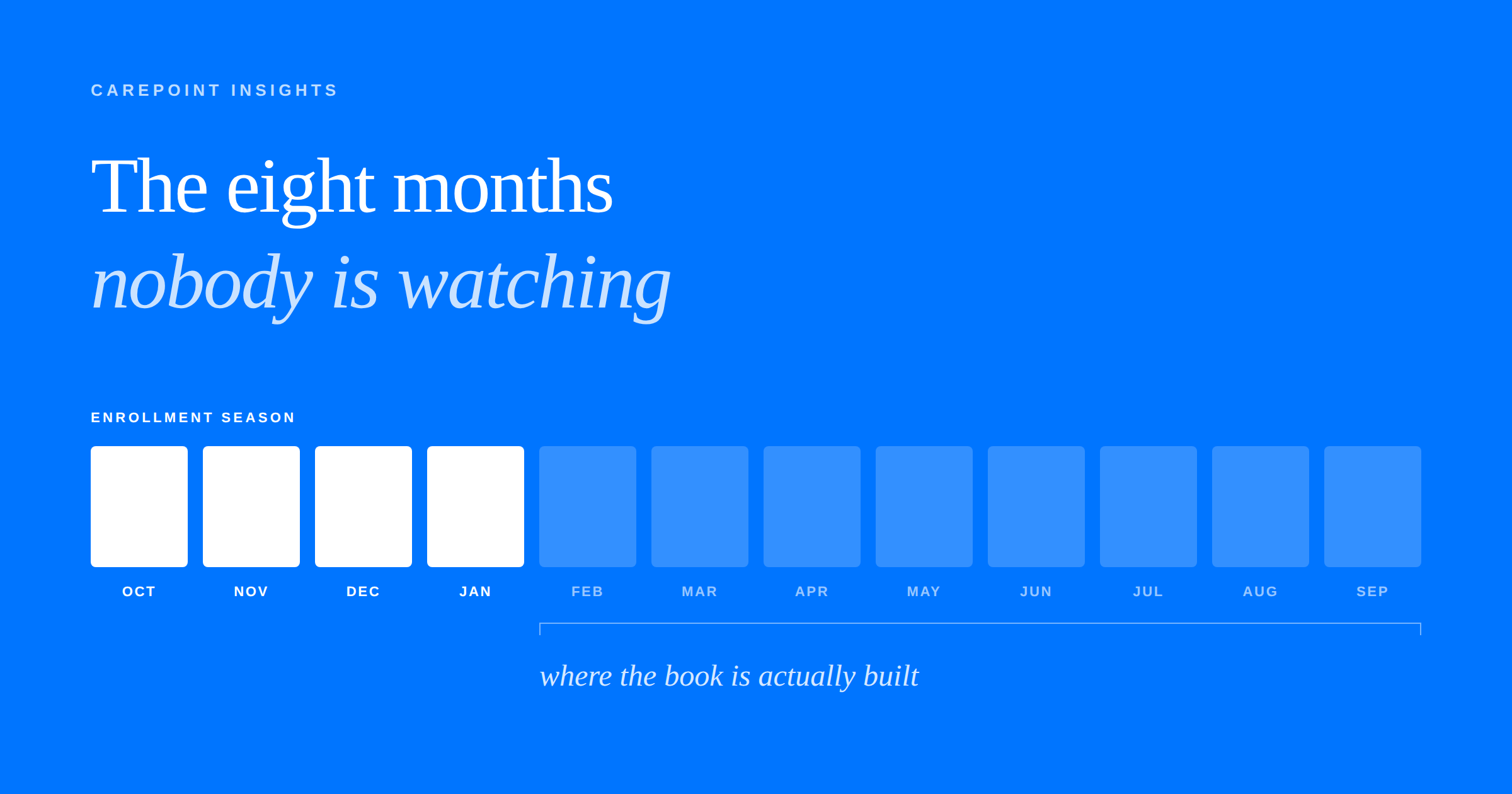
A new client book in the Carepoint portal gives agents one place to track every client relationship, and gives agencies a live view of production pacing.

A Market Under Real PressureThe Medicare Advantage landscape is not just changing.
A new client book in the Carepoint portal gives agents one place to track every client relationship, and gives agencies a live view of production pacing.
A Market Under Real PressureThe Medicare Advantage landscape is not just changing.

The Medicare brokerage landscape is entering a new phase.
The Medicare Advantage market is entering one of the most significant periods of disruption in its history.
Technology-enabled distribution used to be a differentiator. Today, it’s the baseline. Across the insurance landscape, rising costs and increasing complexity...

Carrier marketing dollars are tightening. Not gradually — structurally. Co-op funding — long relied on by agencies to...
Ready to grow with structure?
Whether you're building your book or scaling an agency, Carepoint gives you the tools, access, and support to move forward with confidence.

See how it works
A closer look at our ecosystem, and what makes Carepoint different.
Explore the platform
Speak to our team
Have questions? We’ll walk you through everything and help you decide if it’s the right fit.
Connect with us


Carepoint is an independent organization and is not affiliated with or endorsed by the United States government or the federal Medicare program. We do not represent all plans available in your area. The information provided is limited to the plans we offer. For additional plan options, please visit Medicare.gov or call 1-800-MEDICARE.
© 2026 Carepoint. All rights reserved. By using this website, you agree to our Terms of Service and Privacy Policy & Notices at Collection.
